Progress Report

Made good progress writing the next fantasy/fae/myth story, but recently switched back over to writing the next hard science fiction story again and am making excellent progress there. Also: halfway through another editing pass of my urban supernatural story so beta readers for it will be contacted by the end of the month.

Posted in Uncategorized | Leave a comment

Favorite Passages in Literature…

The Hobbit, by J.R.R Tolkien

This book is one of the all time classics, set in a founding fantasy realm called Middle Earth where many different sentient races (including men, elves, dwarves, orcs, and hobbits) exist across its varied length in uneasy peace, and occasional warfare. But the story begins in the peaceful land of the hobbits, where one Bilbo Baggins is about to get a rude awakening from an old, storied traveler of the outside world…

(pg. 12)

By some curious chance one morning long ago in the quiet of the world, when there was less noise and more green, and the hobbits were still numerous and prosperous, and Bilbo Baggins was standing at his door after breakfast smoking an enormous long wooden pipe that reached nearly down to his woolly toes (neatly brushed)—Gandalf came by. Gandalf! If you had heard only a quarter of what I have heard about him, and I have only heard very little of all there is to hear, you would be prepared for any sort of remarkable tale. Tales and adventures sprouted up all over the place wherever he went, in the most extraordinary fashion. He had not been down that way under The Hill for ages and ages, not since his friend the Old Took died, in fact, and the hobbits had almost forgotten what he looked like. He had been away over The Hill and across The Water on businesses of his own since they were all small hobbit-boys and hobbit-girls.

All that the unsuspecting Bilbo saw that morning was an old man with a staff. He had a tall pointed blue hat, a long grey cloak, a silver scarf over which his long white beard hung down below his waist, and immense black boots.

“Good Morning!” said Bilbo, and he meant it. The sun was shining, and the grass was very green. But Gandalf looked at him from under long bushy eyebrows that stuck out further than the brim of his shady hat.

“What do you mean?” he said. “Do you wish me a good morning, or mean that it is a good morning whether I want it or not; or that you feel good this morning; or that it is a morning to be good on?”

“All of them at once,” said Bilbo. “And a very fine morning for a pipe of tobacco out of doors, into the bargain. If you have a pipe about you, sit down and have a fill of mine! There’s no hurry, we have all the day before us!” Then Bilbo sat down on a seat by his door, crossed his legs, and blew out a beautiful grey ring of smoke that sailed up into the air without breaking and floated away over The Hill.

“Very pretty!” said Gandalf. “But I have no time to blow smoke-rings this morning. I am looking for someone to share in an adventure that I am arranging, and it’s very difficult to find anyone.”

“I should think so—in these parts! We are plain quiet folk and have no use for adventures. Nasty disturbing uncomfortable things! Make you late for dinner! I can’t think what anybody sees in them,” said our Mr. Baggins, and stuck one thumb behind his braces, and blew out another even bigger smoke-ring. Then he took out his morning letters, and began to read, pretending to take no more notice of the old man. He had decided that he was not quite his sort, and wanted him to go away. But the old man did not move. He stood leaning on his stick and gazing at the hobbit without saying anything, till Bilbo got quite uncomfortable and even a little cross.

“Good morning!” he said at last. “We don’t want any adventures here, thank you! You might try over The Hill or across The Water.” By this he meant that the conversation was at an end.

“What a lot of things you do use Good morning for!” said Gandalf. “Now you mean that you want to get rid of me, and that it won’t be good till I move off.”

“Not at all, not at all, my dear sir! Let me see, I don’t think I know your name?”

“Yes, yes, my dear sir—and I do know your name, Mr. Bilbo Baggins. And you do know my name, though you don’t remember that I belong to it. I am Gandalf, and Gandalf means me! To think that I should have lived to be good-morninged by Belladonna Took’s son, as if I was selling buttons at the door!”

“Gandalf, Gandalf! Good gracious me! Not the wandering wizard that gave Old Took a pair of magic diamond studs that fastened themselves and never came undone till ordered? Not the fellow who used to tell such wonderful tales at parties, about dragons and goblins and giants and the rescue of princesses and the unexpected luck of widows’ sons? Not the man that used to make such particularly excellent fireworks! I remember those! Old Took used to have them on Midsummer’s Eve. Splendid! They used to go up like great lilies and snapdragons and laburnums of fire and hang in the twilight all evening!” You will notice already that Mr. Baggins was not quite so prosy as he liked to believe, also that he was very fond of flowers. “Dear me!” he went on. “Not the Gandalf who was responsible for so many quiet lads and lasses going off into the Blue for mad adventures? Anything from climbing trees to visiting elves—or sailing in ships, sailing to other shores! Bless me, life used to be quite inter—I mean, you used to upset things badly in these parts once upon a time. I beg your pardon, but I had no idea you were still in business.”

“Where else should I be?” said the wizard. “All the same I am pleased to find you remember something about me. You seem to remember my fireworks kindly, at any rate, and that is not without hope. Indeed for your old grandfather Took’s sake, and for the sake of poor Belladonna, I will give you what you asked for.”

“I beg your pardon, I haven’t asked for anything!”

“Yes, you have! Twice now. My pardon. I give it you. In fact I will go so far as to send you on this adventure. Very amusing for me, very good for you—and profitable too, very likely, if you ever get over it.”

“Sorry! I don’t want any adventures, thank you. Not today. Good morning! But please come to tea—any time you like! Why not tomorrow? Come tomorrow! Good bye!” With that the hobbit turned and scuttled inside his round green door, and shut it as quickly as he dared, not to seem rude. Wizards after all are wizards.

“What on earth did I ask him to tea for!” he said to himself, as he went to the pantry. He had only just had breakfast, but he thought a cake or two and a drink of something would do him good after his fright.

Gandalf in the meantime was still standing outside the door, and laughing long but quietly. After a while he stepped up, and with the spike on his staff scratched a queer sign on the hobbit’s beautiful green front-door. Then he strode away, just about the time when Bilbo was finishing his second cake and beginning to think that he had escaped adventures very well.

The next day he had almost forgotten about Gandalf. He did not remember things very well, unless he put them down on his Engagement Tablet: like this: Gandalf Tea Wednesday. Yesterday he had been too flustered to do anything of the kind.

Just before tea-time there came a tremendous ring on the front-door bell, and then he remembered! He rushed and put on the kettle, and put out another cup and saucer, and an extra cake or two, and ran to the door.

“I am so sorry to keep you waiting!” he was going to say, when he saw that it was not Gandalf at all. It was a dwarf with a blue beard tucked into a golden belt, and very bright eyes under his dark-green hood. As soon as the door was opened, he pushed inside, just as if he had been expected.

He hung his hooded cloak on the nearest peg, and “Dwalin at your service!” he said with a low bow.

“Bilbo Baggins at yours!” said the hobbit, too surprised to ask any questions for the moment. When the silence that followed had become uncomfortable, he added: “I am just about to take tea; pray come and have some with me.” A little stiff perhaps, but he meant it kindly. And what would you do, if an uninvited dwarf came and hung his things up in your hall without a word of explanation?

They had not been at table long, in fact they had hardly reached the third cake, when there came another even louder ring at the bell.

“Excuse me!” said the hobbit, and off he went to the door.

“So you have got here at last!” That was what he was going to say to Gandalf this time. But it was not Gandalf. Instead there was a very old-looking dwarf on the step with a white beard and a scarlet hood; and he too hopped inside as soon as the door was open, just as if he had been invited.

“I see they have begun to arrive already,” he said when he caught sight of Dwalin’s green hood hanging up. He hung his red one next to it, and “Balin at your service!” he said with his hand on his breast.

“Thank you!” said Bilbo with a gasp. It was not the correct thing to say, but they have begun to arrive had flustered him badly. He liked visitors, but he liked to know them before they arrived, and he preferred to ask them himself. He had a horrible thought that the cakes might run short, and then he—as the host: he knew his duty and stuck to it however painful—he might have to go without.

“Come along in, and have some tea!” he managed to say after taking a deep breath.

“A little beer would suit me better, if it is all the same to you, my good sir,” said Balin with the white beard. “But I don’t mind some cake—seed-cake, if you have any.”

“Lots!” Bilbo found himself answering, to his own surprise; and he found himself scuttling off, too, to the cellar to fill a pint beer-mug, and then to a pantry to fetch two beautiful round seed-cakes which he had baked that afternoon for his after-supper morsel.

When he got back Balin and Dwalin were talking at the table like old friends (as a matter of fact they were brothers). Bilbo plumped down the beer and the cake in front of them, when loud came a ring at the bell again, and then another ring.

“Gandalf for certain this time,” he thought as he puffed along the passage. But it was not. It was two more dwarves, both with blue hoods, silver belts, and yellow beards; and each of them carried a bag of tools and a spade. In they hopped, as soon as the door began to open—Bilbo was hardly surprised at all.

“What can I do for you, my dwarves?” he said.

“Kili at your service!” said the one. “And Fili!” added the other; and they both swept off their blue hoods and bowed.

“At yours and your family’s!” replied Bilbo, remembering his manners this time.

“Dwalin and Balin here already, I see,” said Kili. “Let us join the throng!”

“Throng!” thought Mr. Baggins. “I don’t like the sound of that. I really must sit down for a minute and collect my wits, and have a drink.” He had only just had a sip—in the corner, while the four dwarves sat round the table, and talked about mines and gold and troubles with the goblins, and the depredations of dragons, and lots of other things which he did not understand, and did not want to, for they sounded much too adventurous—when, ding-dong-a-ling-dang, his bell rang again, as if some naughty little hobbit-boy was trying to pull the handle off.

“Someone at the door!” he said, blinking.

“Some four, I should say by the sound,” said Fili. “Besides, we saw them coming along behind us in the distance.”

The poor little hobbit sat down in the hall and put his head in his hands, and wondered what had happened, and what was going to happen, and whether they would all stay to supper. Then the bell rang again louder than ever, and he had to run to the door. It was not four after all, it was five. Another dwarf had come along while he was wondering in the hall. He had hardly turned the knob, before they were all inside, bowing and saying “at your service” one after another. Dori, Nori, Ori, Oin, and Gloin were their names; and very soon two purple hoods, a grey hood, a brown hood, and a white hood were hanging on the pegs, and off they marched with their broad hands stuck in their gold and silver belts to join the others. Already it had almost become a throng. Some called for ale, and some for porter, and one for coffee, and all of them for cakes; so the hobbit was kept very busy for a while.

A big jug of coffee had just been set in the hearth, the seed-cakes were gone, and the dwarves were starting on a round of buttered scones, when there came—a loud knock. Not a ring, but a hard rat-tat on the hobbit’s beautiful green door. Somebody was banging with a stick!

Bilbo rushed along the passage, very angry, and altogether bewildered and bewuthered—this was the most awkward Wednesday he ever remembered. He pulled open the door with a jerk, and they all fell in, one on top of the other. More dwarves, four more! And there was Gandalf behind, leaning on his staff and laughing. He had made quite a dent on the beautiful door; he had also, by the way, knocked out the secret mark that he had put there the morning before.

Posted in Uncategorized | Leave a comment

Currently Reading…

Something More Than Night, by Ian Tregillis.

The premise: set on an earth of the indetermine near future, the archangel Gabriel has just been been murdered, and heaven is aswirl with rumour. A fallen angel, Bayliss, sets off on a noir, detectivive-style hunt to figure out the mystery behind it. But first he has to enlist Gabriel’s replacement, and accidentally christens an abruptly deceased young woman, Molly, to take the archangels vacant place in the pantheon. Then things get really interesting.

A wonderful story. Loved it from start to finish, and would heartily recommend it to anyone interested in supernatural intrigue, angels, demons, or fantasy/sci-fi noir.

Posted in Uncategorized | Leave a comment

Progress Report

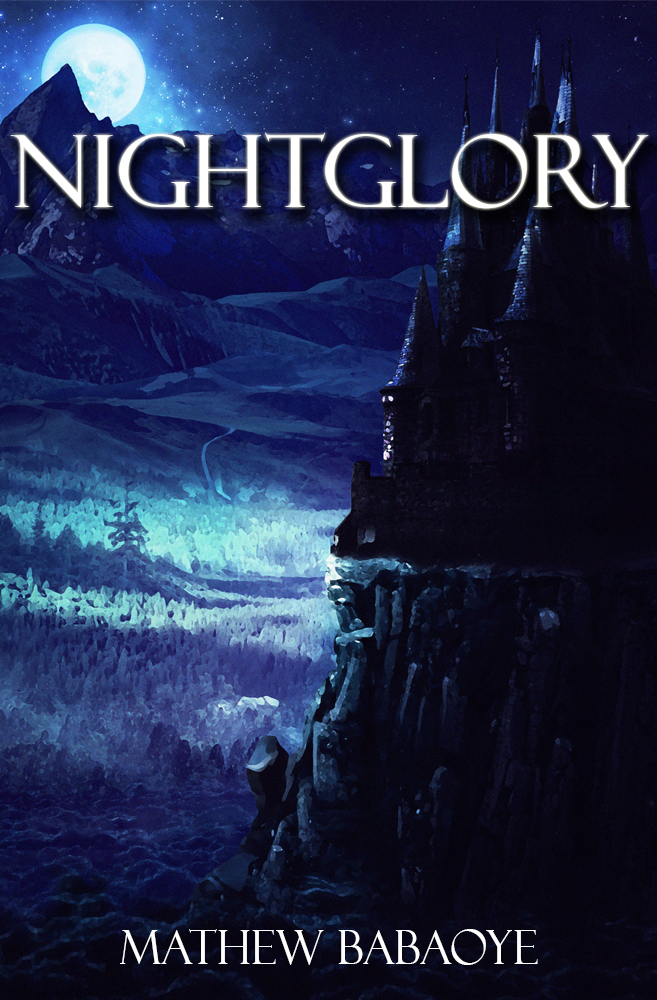
Almost done with the final editing pass of Nightglory and doing minor touch-up work on the cover as well. Things have been really busy lately, but more exciting news is on the horizon in the next couple of months 🙂

Posted in Uncategorized | Leave a comment

Favorite Passages in Literature…

Dune, by Frank Herbet

This book is one of the classics, set in a far future where royal families jockey for position in an empire that spans the galaxy. On Arrakis, the only planet which grows a wondrous drug known as “the spice”, the Harkonens are forced by Imperial Decree to give up their position as contracted rulers to the Atreides. In preperation for this, the Atreides begin packing up the family castle on their home planet, Caladan. And Paul Atreides, a very young son, and heir, with greater promise than most, is woken from a prophetic dream to accept the first test of his impossible fate.

(pg. 5)

The hall door opened and his mother peered in, hair like shaded bronze held with a black ribbon at the crown, her oval face emotionless and green eyes staring solemnly.

“You’re awake,” she said. “Did you sleep well?”

“Yes.”

He studied the tallness of her, saw the hint of tension in her shoulders as she chose clothing for him from the closet racks. Another might have missed the tension, but she had trained him in the Bene Gesserit Way — in the minutiae of observation. She turned, holding a semiformal jacket for him. It carried the red Atreides hawk crest above the breast pocket.

“Hurry and dress,” she said. “Reverend Mother is waiting.”

“I dreamed of her once,” Paul said. “Who is she?”

“She was my teacher at the Bene Gesserit school. Now, she’s the Emperor’s Truthsayer. And Paul . . . ” She hesitated. “You must tell her about your dreams.”

“I will. Is she the reason we got Arrakis?”

“We did not get Arrakis.” Jessica flicked dust from a pair of trousers, hung them with the jacket on the dressing stand beside his bed. “Don’t keep Reverend Mother waiting.”

Paul sat up, hugged his knees. “What’s a gom jabbar?”

Again, the training she had given him exposed her almost invisible hesitation, a nervous betrayal he felt as fear.

Jessica crossed to the window, flung wide the draperies, stared across the river orchards toward Mount Syubi. “You’ll learn about . . . the gom jabbar soon enough,” she said.

He heard the fear in her voice and wondered at it.

Jessica spoke without turning. “Reverend Mother is waiting in my morning room. Please hurry.”

The Reverend Mother Gaius Helen Mohiam sat in a tapestried chair watching mother and son approach. Windows on each side of her overlooked the curving southern bend of the river and the green farmlands of the Atreides family holding, but the Reverend Mother ignored the view. She was feeling her age this morning, more than a little petulant. She blamed it on space travel and association with that abominable Spacing Guild and its secretive ways. But here was a mission that required personal attention from a Bene Gesserit with the Sight. Even the Padishah Emperor’s Truthsayer couldn’t evade that responsibility when the duty call came.

Damn that Jessica! the Reverend Mother thought. If only she‘d borne us a girl as she was ordered to do!

Jessica stopped three paces from the chair, dropped a small curtsy, a gentle flick of left hand along the line of her skirt. Paul gave the short bow his dancing master had taught — the one used “when in doubt of another’s station.”

The nuances of Paul’s greeting were not lost on the Reverend Mother. She said: “He’s a cautious one, Jessica.”

Jessica’s hand went to Paul’s shoulder, tightened there. For a heartbeat, fear pulsed through her palm. Then she had herself under control. “Thus he has been taught, Your Reverence.”

What does she fear? Paul wondered.

The old woman studied Paul in one gestalten flicker: face oval like Jessica’s, but strong bones . . . hair: the Duke’s black hair but with browline of the maternal grandfather who cannot be named, and that thin, disdainful nose; shape of directly staring green eyes: like the old Duke, the paternal grandfather who is dead. Now, there was a man who appreciated the power of bravura — even in death, the Reverend Mother thought.

“Teaching is one thing,” she said, “the basic ingredient is another. We shall see.” The old eyes darted a hard glance at Jessica. “Leave us. I enjoin you to practice the meditation of peace.”

Jessica took her hand from Paul’s shoulder. “Your Reverence, I –”

“Jessica, you know it must be done.”

Paul looked up at his mother, puzzled.

Jessica straightened. “Yes . . . of course.”

Paul looked back at the Reverend Mother. Politeness and his mother’s obvious awe of this old woman argued caution. Yet he felt an angry apprehension at the fear he sensed radiating from his mother.

“Paul . . . ” Jessica took a deep breath. “. . . this test you’re about to receive . . . it’s important to me.”

“Test?” He looked up at her.

“Remember that you’re a duke’s son, ”Jessica said. She whirled and strode from the room in a dry swishing of skirt. The door closed solidly behind her.

Paul faced the old woman, holding anger in check. “Does one dismiss the Lady Jessica as though she were a serving wench?”

A smile flicked the corners of the wrinkled old mouth. “The Lady Jessica was my serving wench, lad, for fourteen years at school.” She nodded. “And a good one, too. Now, you come here!”

The command whipped out at him. Paul found himself obeying before he could think about it. Using the Voice on me, he thought. He stopped at her gesture, standing beside her knees.

“See this?” she asked. From the folds of her gown, she lifted a green metal cube about fifteen centimeters on a side. She turned it and Paul saw that one side was open — black and oddly frightening. No light penetrated that open blackness.

“Put your right hand in the box,” she said.

Fear shot through Paul. He started to back away, but the old woman said: “Is this how you obey your mother?”

He looked up into bird-bright eyes.

Slowly, feeling the compulsions and unable to inhibit them, Paul put his hand into the box. He felt first a sense of cold as the blackness closed around his hand, then slick metal against his fingers and a prickling as though his hand were asleep.

A predatory look filled the old woman’s features. She lifted her right hand away from the box and poised the hand close to the side of Paul’s neck. He saw a glint of metal there and started to turn toward

“Stop!” she snapped.

Using the Voice again! He swung his attention back to her face.

“I hold at your neck the gom jabbar,” she said. “The gom jabbar, the high- handed enemy. It’s a needle with a drop of poison on its tip. Ah-ah! Don’t pull away or you’ll feel that poison.”

Paul tried to swallow in a dry throat. He could not take his attention from the seamed old face, the glistening eyes, the pale gums around silvery metal teeth that flashed as she spoke.

“A duke’s son must know about poisons,” she said. “It’s the way of our times, eh? Musky, to be poisoned in your drink. Aumas, to be poisoned in your food. The quick ones and the slow ones and the ones in between. Here’s a new one for you: the gom jabbar. It kills only animals.”

Pride overcame Paul’s fear. “You dare suggest a duke’s son is an animal?” he demanded.

“Let us say I suggest you may be human,” she said. “Steady! I warn you not to try jerking away. I am old, but my hand can drive this needle into your neck before you escape me.” “Who are you?” he whispered. “How did you trick my mother into leaving me alone with you? Are you from the Harkonnens?”

“The Harkonnens? Bless us, no! Now, be silent.” A dry finger touched his neck and he stilled the involuntary urge to leap away.

“Good,” she said. “You pass the first test. Now, here’s the way of the rest of it: If you withdraw your hand from the box you die. This is the only rule. Keep your hand in the box and live. Withdraw it and die.”

Paul took a deep breath to still his trembling. “If I call out there’ll be servants on you in seconds and you’ll die.”

“Servants will not pass your mother who stands guard outside that door. Depend on it. Your mother survived this test. Now it’s your turn. Be honored. We seldom administer this to men-?children.”

Curiosity reduced Paul’s fear to a manageable level. He heard truth in the old woman’s voice, no denying it. If his mother stood guard out there . . . if this were truly a test . . . And whatever it was, he knew himself caught in it, trapped by that hand at his neck: the gom jabbar. He recalled the response from the Litany against Fear as his mother had taught him out of the Bene Gesserit rite.

“I must not fear. Fear is the mind-killer. Fear is the little death that brings total obliteration. I will face my fear. I will permit it to pass o

ver me and through me. And when it has gone past I will turn the inner eye to see its path. Where the fear has gone there will be nothing. Only I will remain.”

He felt calmness return, said: “Get on with it, old woman.”

“Old woman!” she snapped. “You’ve courage, and that can’t be denied. Well, we shall see, sirra.” She bent close, lowered her voice almost to a whisper. “You will feel pain in this hand within the box. Pain. But! Withdraw the hand and I’ll touch your neck with my gom jabbar — the death so swift it’s like the fall of the headsman’s axe. Withdraw your hand and the gom jabbar takes you. Understand?”

“What’s in the box?”

“Pain.”

He felt increased tingling in his hand, pressed his lips tightly together. How could this be a test? he wondered. The tingling became an itch.

The old woman said; “You’ve heard of animals chewing off a leg to escape a trap? There’s an animal kind of trick. A human would remain in the trap, endure the pain, feigning death that he might kill the trapper and remove a threat to his kind.”

The itch became the faintest burning. “Why are you doing this?” he demanded.

“To determine if you’re human. Be silent.”

Paul clenched his left hand into a fist as the burning sensation increased in the other hand. It mounted slowly: heat upon heat upon heat . . . upon heat. He felt the fingernails of his free hand biting the palm. He tried to flex the fingers of the burning hand, but couldn’t move them.

“It burns,” he whispered.

“Silence!”

Pain throbbed up his arm. Sweat stood out on his forehead. Every fiber cried out to withdraw the hand from that burning pit . . . but . . . the gom jabbar. Without turning his head, he tried to move his eyes to see that terrible needle poised beside his neck. He sensed that he was breathing in gasps, tried to slow his breaths and couldn’t.

Pain!

His world emptied of everything except that hand immersed in agony, the ancient face inches away staring at him.

His lips were so dry he had difficulty separating them.

The burning! The burning!

He thought he could feel skin curling black on that agonized hand, the flesh crisping and dropping away until only charred bones remained. It stopped!

As though a switch had been turned off, the pain stopped.

Paul felt his right arm trembling, felt sweat bathing his body.

“Enough,” the old woman muttered. “Kull wahad! No woman child ever withstood that much. I must’ve wanted you to fail.” She leaned back, withdrawing the gom jabbar from the side of his neck. “Take your hand from the box, young human, and look at it.”

He fought down an aching shiver, stared at the lightless void where his hand seemed to remain of its own volition. Memory of pain inhibited every movement. Reason told him he would withdraw a blackened stump from that box.

“Do it!” she snapped.

He jerked his hand from the box, stared at it astonished. Not a mark. No sign of agony on the flesh. He held up the hand, turned it, flexed the fingers.

“Pain by nerve induction,” she said. “Can’t go around maiming potential humans. There’re those who’d give a pretty for the secret of this box, though.” She slipped it into the folds of her gown.

“But the pain –” he said.

“Pain,” she sniffed. “A human can override any nerve in the body.”

Paul felt his left hand aching, uncurled the clenched fingers, looked at four bloody marks where fingernails had bitten his palm. He dropped the hand to his side, looked at the old woman. “You did that to my mother once?”

“Ever sift sand through a screen?” she asked.

The tangential slash of her question shocked his mind into a higher awareness: Sand through a screen, he nodded.

“We Bene Gesserit sift people to find the humans.”

He lifted his right hand, willing the memory of the pain. “And that’s all there is to it — pain?”

“I observed you in pain, lad. Pain’s merely the axis of the test. Your mother’s told you about our ways of observing. I see the signs of her teaching in you. Our test is crisis and observation.”

He heard the confirmation in her voice, said: “It’s truth!”

She stared at him. He senses truth! Could he be the one? Could he truly be the one? She extinguished the excitement, reminding herself: “Hope clouds observation.”

“You know when people believe what they say,” she said.

“I know it.”

The harmonics of ability confirmed by repeated test were in his voice. She heard them, said: “Perhaps you are the Kwisatz Haderach. Sit down, little brother, here at my feet.”

“I prefer to stand.”

“Your mother sat at my feet once.”

“I’m not my mother.”

Posted in Uncategorized | Leave a comment

Update

Here is my favorite of the three final covers for the fantasy/fae/myth story. Nightglory is coming…

Cover31

Posted in Uncategorized | Leave a comment

Covers

Working on finalizing the cover for the fantasy/fae/myth story with my artists, and will have more to share with you all soon 🙂

Posted in Uncategorized | Leave a comment

Progress Report

Making progress on the final editing pass of the fantasy/fae/myth story, and am contracted with a cover artist to finish artwork within the week. Release is set for the end of November. Otherwise: I am still writing the beginning to another fantasy story. It’s going well so far, and I’m excited to continue exploring this story’s wider world.

Posted in Uncategorized | Leave a comment

Favorite Passages in Literature…

The Phoenix Guard, by Steven Brust

This book is set in a witty, classic science fiction realm of 7-foot tall elves (Dragaerans). 4 young (in other words, being under age 100) Dragaerans, all chance met on the road at the start of a new imperial era ruled by the new Emperor (as dictated by millenia long House Cycles), travel by foot to the capital to join the Imperial Phoenix Guard and join his reign. For fame, adventure, and glory.  

But they are all extremely accomplished fighters, and magic users. So much so that on their first patrol of the city, they each run into seperate misfortunes, as each was assigned a more experience Phoenix Guard to train them. The main character, Khaavren, gets into a scrape, is challenged by his partner, and forced to kill him in a duel. After, each of the 4 friends, returning from their assignments, has an appointment with the Captain, one after the other. Here is how these first day reports start.

(pg. 345)

THEY WALKED BACK to the Dragon Gate, and into the sub-wing of the Imperial Guards, where Khaavren paid each of the four two orbs from the same purse. They left the body in Captain G’aereth’s antechamber, and told the attendant that he wished to see the Captain. This worthy looked at the body and went to give the message. He returned at once, and signed that Khaavren should enter at once.

“Well, my good Tiassa,” said the Captain, motioning Khaavren to a chair. “It seems that something has happened. I am anxious to hear the details.”

“My lord,” said Khaavren, “I will tell you of the entire affair.”

“That is precisely what I wish to hear,” said the Captain.

“That is well. Here it is, then.” And he explained exactly what had occurred, with the precision of detail only a Tiassa is capable of. As he spoke, G’aereth’s eyes became hard. When he had finished, the Captain opened his mouth to speak, but they were interrupted by the attendant, who said that the Cavalier Pel wished to be admitted.

The Captain shrugged, and signed to Khaavren that he should be patient. “Very well,” G’aereth said to the attendant. “Send him in.”

Pel bowed to the pair of them.

“Well?” said the Captain.

“There has been a small misadventure, my lord,” said Pel.

“A misadventure?”

“Precisely.”

“Of what kind?”

“On the part of my partner.”

“Your partner?”

“Yes.”

“She is hurt?”

“Ah! You say, hurt.”

“That is to say, injured.”

“It seems likely.”

“But not badly?” asked G’aereth hopefully.

“On the contrary, my lord.”

“On the contrary?”

“Yes. It is very bad.”

“But, she still lives, does she not?”

“Oh, as to that…”

“Well?”

“I regret to inform your lordship—”

“Lords of Judgement! She is dead, then?”

“It is my sorrowful duty to say it, my Captain.”

“But how did it happen?”

“Oh, it was a strange thing.”

“Well?”

“Well, as we walked along the perimeters of Castlegate, where the revelries of the season were just beginning, my partner and I were discoursing on some subject—”

“On what subject?”

“That is to say… on the subject of…”

“Of dalliance, Cavalier?”

“Oh, certainly not, my Captain!”

As he said this, Khaavren noticed a flush on the pale features of the Yendi, and wondered if the Captain had seen it, too. Pel continued, “It was on the subject of sorcery, my lord.”

“Of sorcery?”

“Yes, She pretended that no one who was not an accomplished sorcerer could have a place in the Imperial Guard.”

“Well, and?”

“I had the honor to inform her that the reign of the Athyra had ended fifteen days ago.”

“Ah.”

“I feel she took my words amiss, for she raised her hands, as if she would cast a spell upon me.”

“Ah! And you?”

“Well, your lordship must understand that I could hardly permit a spell of an unknown sort to take effect on my person. It could have harmful effects. I had no choice but to draw my sword.”

“Oh, but you stopped with drawing it, I hope.”

“Most certainly, my Captain. I recovered myself, and I pleaded with her, as eloquently as I could, not to set out on this hasty course, from which no good could possibly occur.”

“And she? Was she convinced?”

“Entirely.”

“Well?”

“Well, upon seeing the wisdom of my words, she rushed to embrace me, and, in doing so, spitted herself upon my sword.”

“My good Pel!”

“It is as I have the honor to inform you, my Captain.”

“And yet—”

“We were observed by many, my Captain. There should be no difficulty in confirming what I have said.”

“You may assure yourself that I will investigate her death as thoroughly as I investigate the death of Frai.”

“Frai?”

“Khaavren’s partner, whom you doubtless observed in the ante-chamber.”

Pel gave Khaavren a glance full of meaning. “Has your partner also had an accident then?”

“Not at all,” said Khaavren. “We had occasion to fight.”

“Yes,” said G’aereth. “In fact, I was about to say—”

“Hold a moment,” said Pel. “I believe your attendant is calling.”

In fact, at that moment, the door-warden approached to announce the arrival of Aerich.

“Send him in, then,” said the Captain.

Aerich entered, and bowed gracefully to the room at large and to each man present.

“Well,” said G’aereth. “What have you to report?”

“My Lord Captain, it is with sorry that I must report the death of my partner.”

“Her death?”

Aerich bowed.

“But how did she die?”

“I killed her,” said Aerich coolly.

“What?” cried the Captain. “This is infamous!”

Aerich shrugged. Pel and Khaavren exchanged glances.

“How did it happen, then,” said G’aereth. “Did you quarrel?”

“Oh, as to that,” said Aerich. “It took place on the Street of the Cold Fires, at the Circle of the Fountain of the Darr. It was not, you perceive, in a private place, so no doubt you can discover any details that interest you.”

“But I, sir,” said the Captain. “I wish to hear of it from you.”

“Very well,” said the Lyorn, losing none of his coolness. “We did quarrel.”

“Ah! And what did you quarrel about?”

“Diamond mines.”

“Diamond mines?”

Aerich bowed his assent.

Beads of sweat broke out on the Captain’s brow. “How did you quarrel about diamond mines?”

“Your lordship is aware, perhaps, that there have been diamonds discovered in County Sandyhome?”

“I am indeed aware of it, sir, but I am anxious to learn how you became a party to this knowledge.”

“I was told of it.”

“By whom, then, were you told?”

“By my partner.”

“Ah! Well, she told you that diamonds have been discovered. Then what?”

“Your lordship is, no doubt, aware that County Sandyhome, once in the possession of the Empire, is now in the possession of the Easterners.”

“Yes, yes, in fact, it was a Dzur who led the expedition which discovered the diamonds.”

“Furthermore, my lord, you may be aware that there are so many Easterners there that it would be a major campaign for the Imperial army to remove them?”

“I know that indeed, sir.”

“My partner, then, said that the Emperor wished to do exactly that—to mount such a campaign to take this area which has no military value—”

“Oh, as to that…”

“Yes?”

“It has immense economic value.”

Aerich shrugged to signify that he had no opinion of his own on this subject.

“Go on, then,” said the Captain.

“My partner felt that this would be a useless waste of the Imperial armies, when our real project ought to be—you understand, Captain, that these are her words—ought to be the defense of the Pepperfields, which are necessary to the security of the Empire.”

“She is entitled to think whatever she wishes,” said G’aereth.

“That was my opinion, my Lord Captain. I am delighted to find that it coincides with yours.”

“Well, go on, then.”

“It was then, Captain, that my partner made certain statements slandering the character of the Emperor.”

“Ah!”

“We were, as I have had the honor to inform you, in the Circle of the Fountain of the Darr, that is, in a public place, and a place, moreover, filled with Teckla of all sorts. I therefore hastened to inform her, in a quiet voice, that it was the duty of all gentlemen to support and defend the Emperor, and that for those who had the honor to carry a sword in his name, this was twice as true.”

“And she said what to this?” asked the Captain, on whose brow beads of sweat could still be seen.

“She said that her opinion was that of the lady Lytra, the Warlord of the Empire, and that it was not my place to dispute her.”

“And then you said…?”

“I replied that the lady Lytra had not said anything of the kind in my presence, and I doubted that she had said so in a public place, nor would she approve of saying so.”

“And your partner?” asked the Captain, whose breath was now coming in gasps.

“She asked if I pretended to teach her manners.”

“And you?”

“I assured her frankly and sincerely that I was only acting as any gentleman ought to act.”

“By the Orb, sir! She drew her blade, then?”

“Excuse me, Captain, but her blade had been out since I questioned her first statement.”

“Ah! Had you drawn, as well?”

“Not at all,” said Aerich.

“Well, did you then draw it?”

“My partner became adamant on the subject; I felt it rude to refuse.”

“Then she attacked you?”

“Oh, she attacked me, yes.”

“Well?”

“She was very fast, my lord. I was forced to pierce her heart. I called for a healer at once, but, you perceive, it was already too late. I paid a pair of Teckla to keep watch upon her body so it may be brought to Deathgate Falls, should her House deem her worthy of it.”

“But then, among the three of you—”

“Excuse me, Captain,” said Pel, mildly. “The four of us.”

“What is that?”

“I believe I hear the attendant announcing the lady Tazendra.”

G’aereth shook his head. “Send her in, then. I hope she, at least, has a different tale for us.”

Aerich shrugged. Tazendra entered, then, her eyes flashing with the cold anger of a Dzurlord. “My Captain,” she said.

“Yes?”

“It give me great pain, but I must make a complaint.”

“What? A complaint?”

“Yes. Against the individual with whom I was partnered.”

“The Cavalier Fanuial?”

“Yes, that is his name.”

“Well? And your complaint?”

Tazendra drew herself up and flung her long hair over her shoulders, and thrust forward her fine jaw as she said, “He is no gentleman, my lord.”

“How is this?” asked the Captain, astonished.

“My lord, I will tell you the entire history.”

“I ask nothing better.”

“Well, it fell out in this manner. We began our patrol in the hills of the Brambletown district. We arrived, and had hardly set foot upon the Street of Ringing Bells when I saw a young gentleman walking toward us, who seemed to be looking at me quite fixedly.”

“In what way?” asked the Captain.

“Oh, as to that, I am too modest to say.”

The Captain’s eyes traveled from Tazendra’s thick black hair to her finely shaped legs, stopping at all points of interest in between. “Yes, I understand, madam. Go on.”

“I stopped to speak with this young gentleman, who appeared to be a count—” she glanced quickly at the others, cleared her throat and amended, “or perhaps a duke. Yes, undoubtedly a duke, of the House of the Hawk.”

“Well?”

“Well, my partner made remarks about this young noble of—of a particularly rude and personal nature.”

“I see. And what was your response to this?”

“Well, I was tempted to fight, Captain.”

“But you didn’t, I hope?”

“I could not, Captain. You understand, do you not? I am a Dzurlord, he only a Dragon. It would have been dishonorable to attack him.”

“I quite agree,” murmured the Captain. “What did you do, then?”

“Do? Why, naturally I suggested that he find four or five friends, and that, if they would do me the honor to all attack me at once, I would engage to defend this young Hawklord of whom he had spoken so disrespectfully.”

The Captain buried his face in his hands. Out of respect for him, no one spoke.

After a moment, the Captain lifted up his head and said, in a tone noticeably lacking in hope, “He attacked you then?”

“Attacked me? I almost think he did. He drew his sword, which was of tolerably good length, my lord, and rushed me as if it were the Battle of Twelve Pines.”

“And you?”

“Well, not having time to draw my own sword, you understand—”

“Yes, yes, I understand that.”

“Well, I was forced to use a flash-stone.”

“And?”

“I think the charge tore his throat out.”

“Oh,” groaned the Captain.

“And part of his chest.”

“Oh.”

“And penetrated his lungs.”

“Will you have done?”

Tazendra looked mildly startled. “That is all, my lord.”

“I should hope so, for the love of the Emperor.”

Tazendra bowed.

The Captain stood up, and looked at the four of them. “If this is a conspiracy, on the part of Lanmarea or anyone else, I promise you that all of your heads will adorn my wall.”

At the word “conspiracy,” Aerich’s brows contracted. Khaavren managed with some difficulty not to look at the wall to see if there were heads adorning it already.

But the Captain said, “I fear, however, that after interrogating what witnesses I can, I will discover that you have all told the truth. And then, my friends, then what am I to do?”

They didn’t answer. He looked from one to the other. “If that is the case,” he said at last, “it seems plain that, whatever you do, you are so valuable that I must either have you with me or have you dead.”

He chewed his thumb. “It is also plain,” he said, “that I cannot have you on duty with my other Guardsmen—we can’t afford it. In the future you must patrol and team only with each other.”

Pel bowed low at this and looked in the Captain’s eyes. He said in his mild voice,

“Captain my lord G’aereth.”

“Well?”

“We ask nothing better.”

Posted in Uncategorized | Leave a comment

Currently Reading…

The Goblin Emperor, by Katherine Addison.

The premise: in the Elflands, the Emperor and his three sons die in a tragic airship crash, leaving the only heir his reviled, half-blood son, Maia. Dubbed the Goblin Emperor, he must navigate the labrynthine politics of his new seat of power, the Imperial Court. Who can he trust? Who must he plot against? And who was behind the airship crash, which is eventually deemed foul play?

Just a great story so far. Maia is a wonderful, sensitive character, and the court really comes alive. You will want to root for the half-blood to succeed.

Posted in Uncategorized | Leave a comment